Geopolitical fragmentation and constrained supply are creating a new investment backdrop across energy, metals and mining
London, 27 August 2026. The technologies expected to define the future are becoming increasingly dependent on the natural resources associated with the “old economy”, creating a potentially supportive backdrop for natural-resource equities.
AI, data centres and electrification are increasing demand for power, infrastructure and raw materials at a time when geopolitical fragmentation is making resource security increasingly important and years of capital discipline have constrained the supply response across parts of the natural-resources complex.
Paul Gooden, Head of Natural Resources: “The artificial intelligence revolution has a very real physical footprint. AI may live in the cloud, but data centres need enormous amounts of power and metals such as copper and aluminium. The ethereal world of technology still needs the material world to function.”
This is part of a broader shift in the investment environment for natural resources, as geopolitical fragmentation changes the way governments and companies think about access to energy and raw materials.
Russia’s invasion of Ukraine, conflict in the Middle East, US-China tensions and the return of global tariff tensions all point towards a more multipolar global economy. What matters for investors is not predicting the next geopolitical event but recognising the structural shift towards a more fragmented global system.
Governments and companies increasingly want greater certainty over where critical resources will come from. That can mean holding more inventory, encouraging domestic production or securing access to resources from trusted partners.
Gooden: “For decades, globalisation allowed countries to assume they could access the resources they needed from wherever they could be produced most efficiently. That assumption is becoming harder to make. In a more multipolar world, access to energy and raw materials is becoming strategically important again. That is potentially less efficient and more inflationary, but it also creates a more supportive backdrop for natural resources.”
The consequences are appearing across the natural-resources complex. Oil markets are being reshaped by conflict and concerns over resource security. Gold is benefiting from geopolitical uncertainty, fiscal pressures and central-bank buying. While copper and aluminium sit at the heart of electrification, grids and digital infrastructure.
Not another commodity supercycle
Today’s environment is distinct from the commodity supercycle of the 2000s. That cycle was dominated by an extraordinary demand shock as China’s rapid industrialisation and urbanisation consumed vast quantities of energy and raw materials. Today’s cycle is more nuanced – the demand picture is solid (AI, data centres, electrification and infrastructure provide a tailwind), but the real differentiator is the supply side.
Following years in which aggressive investment in new production frequently destroyed shareholder value and ultimately created excess supply, natural-resource companies have become considerably more disciplined. Investors have increasingly demanded that companies prioritise returns over production growth, generate free cash flow and return capital through dividends and share buybacks.
Gooden said: “I wouldn’t call this another commodity supercycle. The 2000s were fundamentally a China demand story. This time, new sources of demand — including AI and data centres — are meeting a much more constrained supply response as companies remain disciplined about adding production.
“In some respects, this is the revenge of the old economy. Markets have spent years focused on the increasingly intangible economy, but the technologies expected to define the future still have to be built and powered. That requires energy, metals and physical infrastructure.”
A different starting point
The improving structural backdrop comes after a prolonged period in which commodities have derated significantly relative to equities. The ratio of the Bloomberg Commodity Index to the Dow Jones remains towards the lower end of its long-term historical range, highlighting the extent to which commodities have fallen out of favour relative to equities.
Commodities and natural resource equities have experienced a period of relative derating
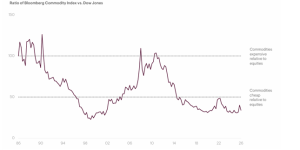
Source: Bloomberg, Ninety One 30 June 2026
Gooden: “Natural resources have spent a long period out of favour, but the fundamental backdrop is changing. Resource security is becoming more important, new sources of demand are emerging and supply remains disciplined. What makes that particularly interesting for investors is the starting point: expectations and valuations are fairly low versus history.”.
Cash flows today, not tomorrow
The investment case for natural resource equities is not solely dependent on higher commodity prices. It is also about the companies producing them.
The average free-cash-flow yield of companies in Ninety One’s natural resources portfolio is currently around 8%, compared with approximately 4% for the broader equity market[1]. This distinction is particularly relevant in an environment of higher bond yields. Many companies that have led equity markets are effectively long-duration assets, with a significant proportion of their value dependent on profits expected far into the future. Natural-resource companies frequently look different.
Gooden: “Many natural-resource companies are generating substantial cash flows today. Growth may be lower than in some parts of the equity market, but these companies are producing cash, paying dividends and buying back shares rather than relying on profits many years into the future.”
Natural resources remain cyclical, however, and higher commodity prices are not unambiguously positive. Prices that rise far enough to weaken economic activity can ultimately destroy demand, making valuation, cost position and security selection critical. But the structural backdrop has changed.
Gooden concluded: “The demand outlook is buoyed by a desire to hold more inventory in a fragmenting global economy, and by the AI mega-theme which requires metals and energy to power it. Meanwhile, on the supply side, miners and drillers remain disciplined. The ethereal world needs the material world. The future may be digital, but it will still have to be built, powered and mined.”
[1] Bloomberg, June 2026. Index = MSCI ACWI
About Ninety One
Ninety One is an active, global investment manager managing £184 billion in assets (30.06.26). Our goal is to provide long-term investment returns for our clients while making a positive difference to people and the planet. Established in South Africa in 1991, as Investec Asset Management, the firm began as a small start-up offering domestic investments in an emerging market. In 2020, as a global firm proud of our emerging market roots, we demerged to become Ninety One. We are committed to developing specialist investment teams organically. Our heritage and approach let us bring a different perspective to active and sustainable investing across equities, fixed income, multi-asset and alternatives to our clients – institutions, advisors and individual investors around the world.
For more information, please visit NinetyOne.com
—